



QL credit, or Quantitative Literacy credit, is a foundational academic requirement in many U.S. colleges and universities. It ensures students develop essential mathematical reasoning and critical thinking skills applicable to everyday life, professional settings, and civic engagement. Unlike traditional math courses that emphasize advanced algebra or calculus, QL credit focuses on practical problem-solving, data interpretation, and numerical analysis in real-world scenarios.
Students often fulfill this requirement through designated college courses, qualifying AP exam scores, ACT/SAT scores, or transfer credits. The emphasis is on using quantitative information effectively rather than mastering abstract formulas. By integrating quantitative literacy into general education, colleges prepare graduates to make informed decisions, analyze statistics critically, and navigate a data-driven world with confidence and accuracy.
Understanding QL Credit in Higher Education
Quantitative Literacy, or QL credit, represents a general education requirement designed to equip students with essential numerical reasoning skills. It prioritizes real-world application, making it highly relevant in a society dominated by data, technology, and statistics.
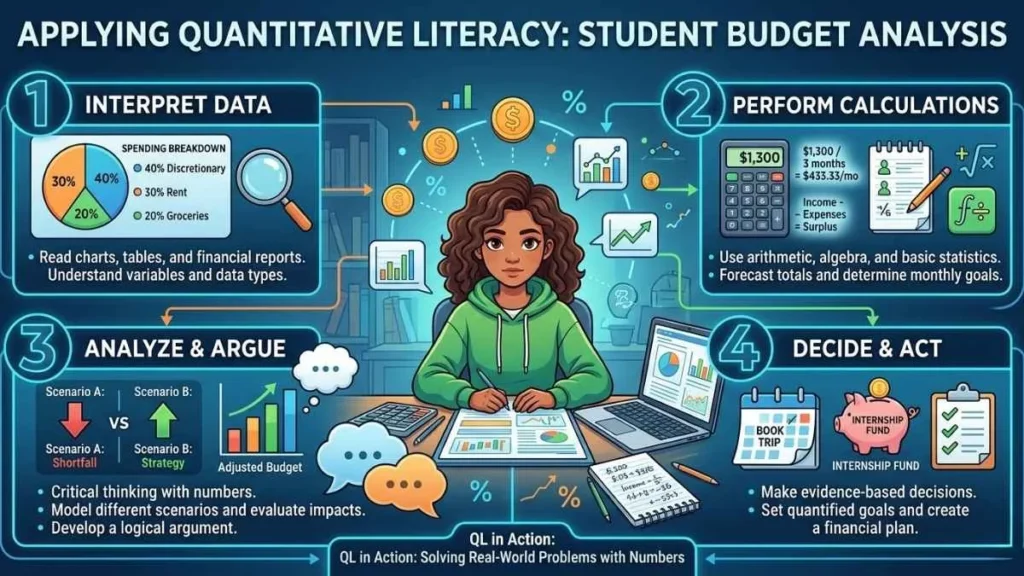
Unlike courses focused solely on theoretical mathematics, QL courses train students to interpret graphs, assess statistics, and solve practical problems. Students learn to evaluate claims in media, understand probability, and make informed decisions in personal finance and professional contexts. This focus ensures that graduates are not only proficient in calculations but can also critically analyze and apply quantitative information in daily life.
Why QL Credit Matters
Quantitative literacy is increasingly recognized as a vital competency for academic success and professional readiness.
- Data Interpretation Skills: Students learn to read charts, tables, and graphs accurately.
- Improved Decision-Making: Ability to apply numerical reasoning in personal and professional life.
- Civic and Financial Literacy: Critical evaluation of statistics in news, politics, and finance.
- Career Preparedness: Skills relevant across industries, from healthcare and education to business analytics.
By emphasizing applied reasoning over abstract concepts, QL credit ensures students are prepared for a data-centric world while fostering critical thinking abilities that transcend academic disciplines.
How QL Credit Differs from Traditional Math
While traditional mathematics courses often focus on procedural skills and abstract theory, QL emphasizes practical reasoning.
QL courses focus on applied mathematics, such as interpreting statistics, analyzing probability, understanding financial calculations, and evaluating quantitative claims in everyday scenarios. This distinction makes QL credit more accessible for students from diverse academic backgrounds while remaining highly relevant to personal, professional, and civic life.
Pathways to Fulfill QL Credit
Students can complete QL requirements through multiple pathways, offering flexibility depending on academic background and prior experience.
1. Designated College Courses
Most students satisfy QL credit by enrolling in approved courses such as Introduction to Statistics, Quantitative Reasoning, or Mathematical Modeling. Some colleges also allow certain algebra courses to meet QL requirements. These courses emphasize real-world applications rather than abstract calculations.
2. Advanced Placement (AP) Exams
High-achieving students can earn QL credit by scoring qualifying marks on AP exams like AP Statistics or AP Calculus. Policies vary by institution, so students should confirm with their academic advisor to ensure proper credit transfer.
3. Standardized Test Scores
Some colleges grant QL credit or waive placement requirements based on ACT or SAT math section scores. This option can accelerate degree progress for students who demonstrate strong quantitative skills early.
4. Transfer Credits
Students transferring from other colleges may fulfill QL requirements if previous coursework aligns with the institution’s QL standards. Official transcript evaluation ensures equivalency and proper credit assignment.
5. Placement Exams
Certain universities administer placement tests allowing students to demonstrate quantitative competency without taking additional courses. Success in these exams can satisfy QL credit and guide students to appropriately leveled math courses.
Core Learning Outcomes

QL courses aim to develop essential quantitative reasoning competencies:
| Competency | Description | Example |
| Interpretation | Understanding quantitative data | Reading population trends in graphs |
| Representation | Translating real-world problems into mathematical models | Calculating loan payments |
| Calculation | Accurate and efficient computations | Determining percentages in survey data |
| Application | Applying math in practical scenarios | Budgeting, risk analysis |
| Analysis | Critically evaluating quantitative arguments | Detecting errors in statistics |
Common Topics in QL Courses
Quantitative literacy coursework often incorporates applied, real-world examples to enhance understanding:
- Personal finance calculations, including loans and interest
- Statistical claims in advertising and media
- Probability in decision-making and risk assessment
- Interpretation of polling and demographic data
- Analysis of environmental or healthcare statistics
Assignments frequently involve case studies rather than abstract problems, helping students connect numerical reasoning with practical life situations.
FAQs
Can QL credit be satisfied through online courses?
Yes, many colleges accept accredited online courses to fulfill QL credit requirements.
Is QL credit required for all U.S. college majors?
Most colleges require QL credit as part of general education, though some majors may have specific alternatives.
Does QL credit include learning software tools like Excel or SPSS?
QL credit focuses on numerical reasoning, but some courses integrate tools like Excel or SPSS for data analysis.
Conclusion
Completing QL credit strengthens analytical thinking, enhances employability, and promotes personal and financial literacy. Whether fulfilled through college courses, AP exams, standardized tests, or transfer credits, QL credit ensures that students graduate with essential numeracy skills. As technology and data continue to shape society, quantitative literacy remains a vital skill set that empowers individuals to navigate complex information, solve real-world problems, and make decisions with confidence.