



The Hellman key or Diffie-Hellman (DH) key exchange changed everything by allowing two parties to generate a shared secret key across a public, insecure network such as the Internet. Even if an attacker intercepts every message exchanged during the process, they cannot realistically determine the final secret key.
Today, variations of Diffie-Hellman remain fundamental to VPNs, encrypted messaging apps, HTTPS connections, and countless other security systems.
What Is the Diffie-Hellman Key Exchange?
The Diffie-Hellman (DH) key exchange is a cryptographic protocol that enables two parties to establish a common secret key without directly transmitting that key. The protocol itself does not encrypt data. Instead, it creates a secret value that can later be used as an encryption key for secure communication.
Think of it as securely agreeing on a lock combination before placing sensitive information inside the safe.
How Diffie-Hellman Works: A Simplified Example
To understand the concept, imagine Alice and Bob want to communicate securely.
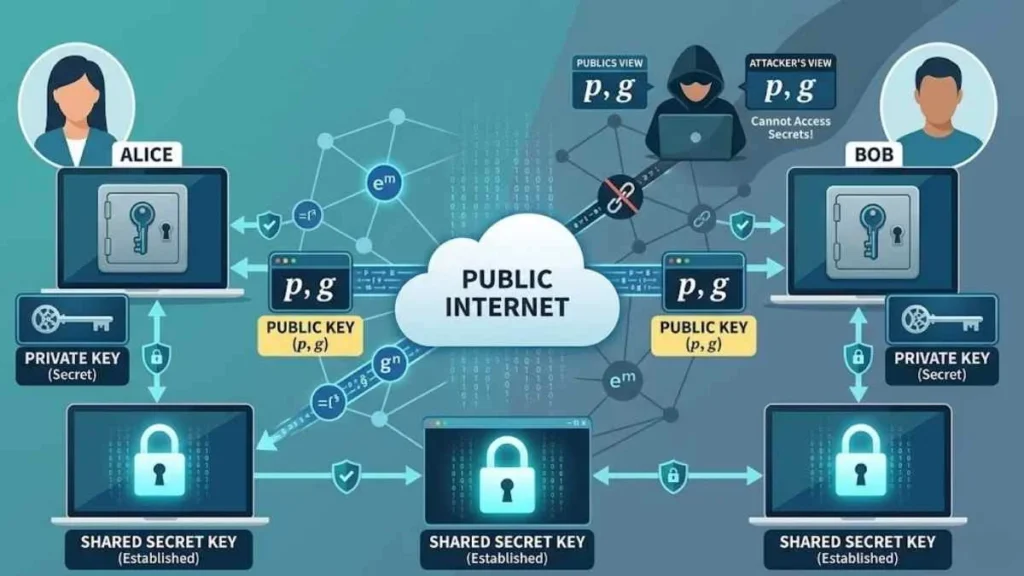
Step 1: Choose Public Values
Alice and Bob agree on two public numbers:
- A large prime number
- A generator number
These values are not secret and can be seen by anyone.
Step 2: Create Private Secrets
Each participant selects a private number:
- Alice chooses a secret number.
- Bob chooses a different secret number.
These values never leave their devices.
Step 3: Generate Public Keys
Using mathematical operations, each side combines the public values with their private secret to create a public key.
They exchange these public keys openly.
Step 4: Calculate the Shared Secret
Each participant performs another calculation using:
- Their own private number
- The other person’s public key
Although the calculations are performed separately, both arrive at exactly the same shared secret.
That shared secret can then be used as an encryption key.
The Paint Mixing Analogy
A common way to visualize Diffie-Hellman is through paint colors.
Imagine:
- Public paint color = Yellow
- Alice’s secret color = Blue
- Bob’s secret color = Red
Both mix yellow with their secret color and exchange the results publicly.
An observer can see:
- Yellow
- Green (Yellow + Blue)
- Orange (Yellow + Red)
However, the observer does not know the original secret colors. Alice then mixes Bob’s public mixture with her secret color. Bob mixes Alice’s public mixture with his secret color. Both end up with the same final color, while outsiders cannot easily determine how it was created.
While not mathematically identical, this analogy captures the core idea behind Diffie-Hellman.
Why Eavesdroppers Cannot Discover the Hellman key
The security of Hellman key relies on a mathematical challenge known as the Discrete Logarithm Problem.
While it is easy to compute a public value from a private secret, reversing the process is computationally difficult when sufficiently large numbers are used.
An attacker may know:
- All public parameters
- Every exchanged message
- The communication channel
What they do not know are the private secrets chosen by each participant.
Without those secrets, deriving the final shared key becomes impractical using current computing capabilities.
Where Diffie-Hellman Is Used Today
Although the original protocol has evolved over time, its core principles remain widely used.
Common applications include:
HTTPS and Secure Websites
When you visit a secure website, key exchange mechanisms often help establish encrypted sessions that protect your data from interception.
Virtual Private Networks (VPNs)
VPNs frequently use Hellman key variants to negotiate secure session keys between clients and servers.
Secure Messaging Apps
Many encrypted messaging platforms use modern forms of Hellman key to establish end-to-end encryption.
SSH Connections
System administrators often rely on secure shell protocols that use key exchange mechanisms inspired by Hellman key.
Modern Variants of Hellman key
Technology has advanced significantly since 1976, leading to more efficient implementations.
Ephemeral Diffie-Hellman (DHE)
Temporary keys are generated for each session.
Benefits include:
- Better privacy
- Stronger protection against future compromises
- Forward secrecy
Elliptic Curve Diffie-Hellman (ECDH)
ECDH uses elliptic curve mathematics instead of traditional modular arithmetic.
Advantages include:
- Smaller key sizes
- Faster computations
- Strong security
- Reduced bandwidth requirements
Today, ECDH is commonly used in modern internet protocols.
Limitations and Security Considerations
Hellman key is powerful, but it is not perfect on its own.
One important weakness is vulnerability to a Man-in-the-Middle (MITM) attack if authentication is absent.

In such a scenario, an attacker could intercept communications and establish separate keys with each participant while pretending to be the other party.
Frequently Asked Questions
Is Hellman key an encryption algorithm?
No. Hellman key is a key exchange protocol. It creates a shared secret that can later be used by encryption algorithms such as AES.
Why is it called the Hellman key exchange?
The protocol is named after its inventors, Whitfield Diffie and Martin Hellman, who introduced the concept in 1976.
Is the Hellman key still used today?
Yes. Modern variants such as ECDH and DHE remain essential components of secure internet communications.
Conclusion
The Hellman key exchange solved one of the most important problems in computer security: how two strangers can establish a shared secret across an insecure network. Its elegant mathematical design allows public communication without exposing private keys, making secure online interactions possible on a global scale.
Although modern systems often use advanced versions such as ECDH and DHE, the underlying idea remains the same as it was nearly fifty years ago. Every time a secure website loads, a VPN connects, or an encrypted message is sent, the principles pioneered by Diffie and Hellman continue to protect digital communication around the world.