



Cumhuriyet is the Turkish word for republic and refers to a system of government based on national sovereignty, democratic participation, and equal civic rights. Cumhuriyet defines a political order where authority belongs to the people rather than a monarch, shaping the identity and legal structure of modern Turkey since 1923.
- Historical Roots of the Republic in Turkey
- Core Principles That Define the Republican Model
- Key Milestones in the Development of the Republic
- The Role of Cumhuriyet Newspaper in Democratic Culture
- Secularism and Civic Identity in the Modern State
- How the Republic Adapts in the Digital Age
- Why the Republican Idea Still Matters
- FAQs
- Conclusion
Cumhuriyet also represents a historical transformation. With the founding of the Republic of Turkey under Mustafa Kemal Atatürk in 1923, the country shifted from imperial rule to a constitutional republic built on secular governance and citizen representation. The term is further associated with the daily newspaper Cumhuriyet, established in 1924, known for its secular and center-left editorial stance.
Historical Roots of the Republic in Turkey
The proclamation of the Republic of Turkey on October 29, 1923, formalized a new political era. Led by Mustafa Kemal Atatürk, the transition replaced the Ottoman imperial structure with a nation-state grounded in popular sovereignty.
This transformation was not symbolic. It redefined law, education, governance, and citizenship. The abolition of the sultanate and later the caliphate removed dynastic and religious authority from state control. A civil legal system inspired by European models replaced religious courts, reinforcing secularism and equality before the law.
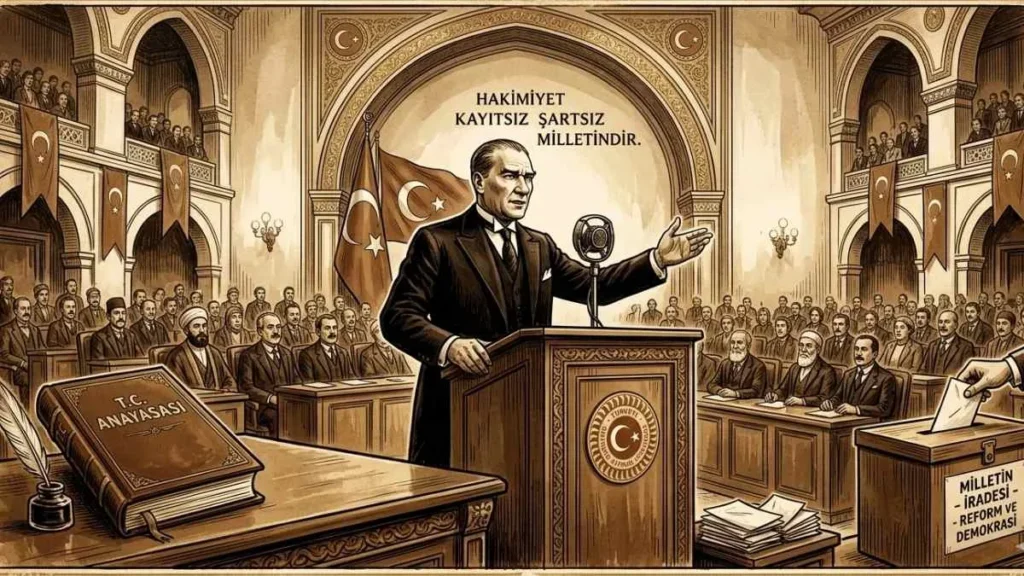
Core Principles That Define the Republican Model
- National sovereignty belongs to the people
- A secular state structure separates religion and governance
- The rule of law ensures equality for all citizens
- Representative democracy through elections
- Civic identity over dynastic loyalty
Together, these values define modern Turkish democracy and shape how institutions function today.
Key Milestones in the Development of the Republic
| Year | Event | Significance |
| 1922 | Abolition of the Sultanate | End of dynastic rule |
| 1923 | Proclamation of the Republic | Birth of the modern nation-state |
| 1924 | Abolition of the Caliphate | Secular state consolidation |
| 1928 | Alphabet Reform | Cultural and educational modernization |
| 1934 | Women were granted full voting rights | Expansion of civic equality |
The Role of Cumhuriyet Newspaper in Democratic Culture
In 1924, the daily newspaper Cumhuriyet was founded to reflect and defend republican values. From its early years, the publication positioned itself as a secular and center-left voice in Turkish media.
The newspaper contributed to democratic culture through investigative reporting and opinion writing. It often addressed constitutional debates, human rights discussions, and institutional transparency. By doing so, it reinforced the public understanding of civic responsibility within the republic.
Secularism and Civic Identity in the Modern State
Secularism remains a defining feature of the Turkish political system. Within the framework of Cumhuriyet, secular governance ensures that state authority operates independently from religious institutions. This approach supports equal treatment of citizens regardless of belief.
Civic identity also shifted dramatically after 1923. Under the Ottoman Empire, loyalty centered on the dynasty and religion. With the establishment of the republic, citizenship became the foundation of belonging. Legal equality replaced inherited privilege. This transformation strengthened public institutions and shaped the political culture of modern Turkey.
How the Republic Adapts in the Digital Age
The modern era has introduced new challenges and opportunities for republican governance. Digital transformation, artificial intelligence, and fast information networks are reshaping how citizens interact with news, politics, and institutions. In this evolving environment, the republican system continues to adapt while maintaining its core democratic principles.

Digital Transformation and Public Communication
The rise of digital platforms has changed how political information is shared. Citizens now access news instantly, which increases awareness but also creates challenges in verifying accuracy. Governments and institutions must respond with transparent communication strategies.
Artificial Intelligence and Information Flow
AI-driven content systems are influencing how information is created and distributed. While they improve efficiency, they also raise concerns about misinformation, bias, and reduced editorial oversight. This shift makes human-verified journalism more important than ever.
Social Media and Democratic Debate
Social media platforms have become major spaces for political discussion. They allow wider participation but can also amplify polarization. In a republican system, maintaining balanced discourse is essential for healthy democratic engagement.
Role of Independent Journalism in the Digital Era
Established media institutions such as Cumhuriyet continue to provide verified reporting and editorial analysis. In a digital environment shaped by speed and automation, independent journalism ensures accountability and fact-based public information.
Why the Republican Idea Still Matters
The strength of any republic depends on citizen participation and institutional balance. Elections, independent courts, legislative oversight, and responsible journalism all contribute to stability.
Cumhuriyet continues to symbolize democratic governance rooted in public will. It reflects a political order that prioritizes civic equality and national sovereignty. While political systems evolve, the foundational concept remains a reference point in legal and academic discussions.
FAQs
1. Is Cumhuriyet celebrated as a national holiday in Turkey?
Yes, Republic Day is celebrated annually on October 29 across the country.
2. Does the concept of Cumhuriyet exist in other countries?
Yes, many nations use the republic model, though structures differ based on constitutional design.
3. How does secularism function within Turkish governance?
It ensures state institutions operate independently from religious authority while protecting freedom of belief.
Conclusion
Cumhuriyet represents the transformation of Turkey into a sovereign republic built on democratic principles and civic rights. Established in 1923 under Mustafa Kemal Atatürk, it replaced imperial rule with constitutional governance centered on the people.
The enduring relevance of this model can be seen in public institutions, electoral systems, and independent media such as Cumhuriyet newspaper. As technology and global dynamics reshape political communication, the principles of national sovereignty, secular governance, and citizen participation continue to guide the evolution of modern Turkey.