



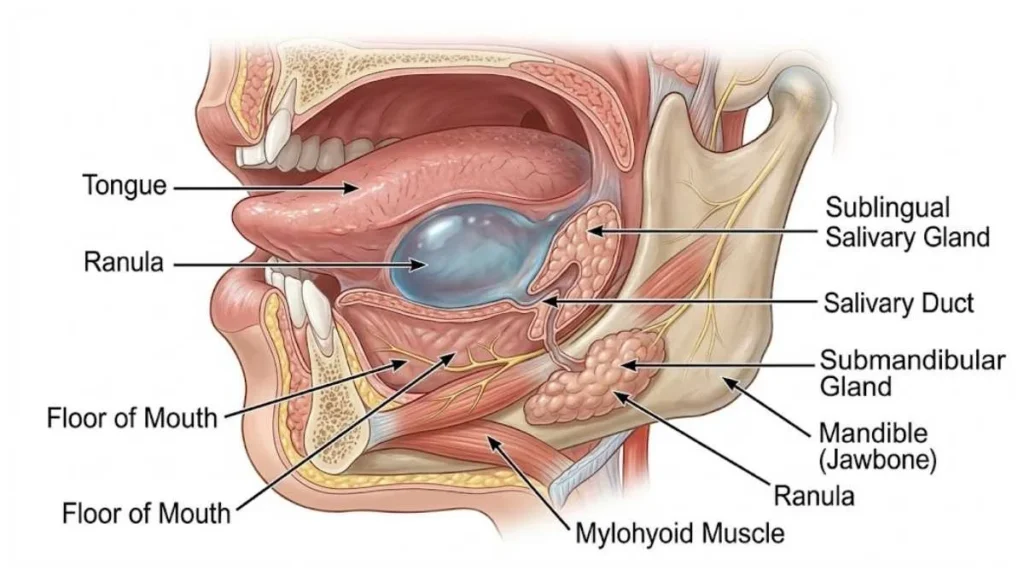
A ranula is a mucus-filled swelling that develops beneath the tongue. Rather than being a true cyst lined with epithelial tissue, it is often considered a mucous extravasation pseudocyst, meaning saliva escapes from a damaged salivary duct and collects within nearby tissues.
The name comes from the Latin word rana, meaning frog, because the translucent swelling can resemble a frog’s underbelly. They can occur in both children and adults, though they are frequently diagnosed in younger individuals.
Why Does a Ranula Form?
The underlying problem is usually damage or blockage involving the sublingual salivary gland.
Salivary Duct Injury
A minor injury to the mouth may damage a salivary duct, allowing saliva to leak into surrounding tissues.
Blocked Salivary Ducts
A duct can become obstructed, preventing saliva from draining normally. Pressure builds up, leading to swelling and saliva accumulation.
Chronic Inflammation
Inflammation affecting salivary glands may increase the risk of duct disruption and mucus leakage.
Congenital Factors
In some cases, anatomical variations present from birth may contribute to ranula formation.
Types
Not all behave the same way.
Simple Ranula
A simple ranula remains confined to the floor of the mouth.
Typical features include:
- Visible swelling beneath the tongue
- Mild discomfort
- Gradual enlargement over time
Plunging Ranula
A plunging ranula extends beyond the floor of the mouth into deeper tissues of the neck.
Signs may include:
- Neck swelling
- A feeling of fullness beneath the jaw
- Less obvious swelling under the tongue
- Cosmetic concerns due to neck enlargement
Plunging ranulas are generally more complex and often require specialist evaluation.
Symptoms that one might see
Small ranulas may cause few noticeable problems. As they enlarge, symptoms become more apparent.
Common symptoms include:
- Soft lump under the tongue
- Bluish, translucent swelling
- Difficulty speaking clearly
- Discomfort while eating
- Sensation of fullness in the mouth
- Trouble swallowing larger bites of food
- Recurrent swelling that changes in size
Large ranulas can occasionally displace the tongue, making everyday activities more difficult.
What Patients Often Notice First
Many people initially describe the lesion as:
“A bubble under my tongue that doesn’t go away.”
Unlike a temporary irritation or canker sore, a ranula tends to persist and may slowly enlarge over weeks or months.
How Is It Diagnosed?
Diagnosis typically begins with a clinical examination by a dentist, oral surgeon, or ear, nose, and throat (ENT) specialist.
The healthcare provider will evaluate:
- Size and location of the swelling
- Color and texture
- Duration of symptoms
- Changes in swallowing or speech
Imaging Studies
If the diagnosis is uncertain or a plunging ranula is suspected, imaging may be recommended.
Common options include:
- Ultrasound
- CT scan
- MRI
These tests help determine the extent of the lesion and identify the involved salivary gland.
Treatment Options
Treatment depends on the size, symptoms, and likelihood of recurrence.
Observation
Very small, asymptomatic ranulas may simply be monitored.
However, spontaneous resolution is not always reliable, and recurring enlargement often prompts treatment.
Drainage
Temporary drainage can reduce swelling, but the cyst frequently returns because the source of saliva leakage remains.
For this reason, drainage alone is generally not considered a definitive solution.
Marsupialization
This procedure creates a permanent opening that allows saliva to drain into the mouth rather than accumulating in tissues.
Benefits include:
- Relatively straightforward procedure
- Short recovery period
- Preservation of surrounding structures
However, recurrence remains possible in some cases.
Surgical Removal of the Sublingual Gland
Many specialists consider removal of the affected sublingual gland the most effective treatment for recurrent or persistent ones.
Advantages include:
- Lower recurrence rates
- Addresses the underlying source of saliva leakage
- Effective for both simple and many plunging ranulas
The exact approach depends on the individual’s anatomy and clinical situation.
Recovery and Prognosis
Most people recover well following treatment. During recovery, patients may experience mild swelling, temporary discomfort, dietary restrictions for several days, and instructions for enhanced oral hygiene.
Most individuals return to normal activities relatively quickly. When the underlying gland is appropriately treated, long-term outcomes are generally excellent, and recurrence becomes much less likely.
When Should You Seek Medical Attention?
A swelling under the tongue should be professionally evaluated if it:

- Persists longer than two weeks
- Continues growing
- Interferes with eating or speaking
- Causes swallowing difficulties
- Recurs after previous treatment
- Is associated with neck swelling
Frequently Asked Questions
Is a ranula cancerous?
No. Ranulas are benign saliva-filled lesions and are not considered cancer. Nevertheless, any persistent oral swelling should be examined by a healthcare professional.
Can I pop a ranula myself?
No. Attempting to puncture or drain a ranula at home can introduce infection and usually does not solve the underlying problem.
Who treats a ranula?
Diagnosis and treatment are commonly performed by dentists, oral and maxillofacial surgeons, or ENT specialists.
Conclusion
A ranula is a saliva-filled swelling that forms beneath the tongue when saliva escapes from a damaged or blocked salivary gland, most often the sublingual gland. Although usually harmless, it can become uncomfortable, interfere with normal oral function, and occasionally extend into the neck as a plunging ranula. Early evaluation is important because effective treatment depends on identifying the underlying source of saliva leakage. With proper diagnosis and management, most patients experience excellent outcomes and lasting relief from symptoms.